Wednesday, 13 November 2013

The Neanderthal Within: The Science of Cousin-Lovin’

One of the most interesting facts in the study of human evolution is that for a very long stretch of time (much longer than modern humans have existed) there were multiple species of humans running around the planet trying to make their way. We (Homo sapiens sapiens) represent the only surviving species on the branch on the tree of life known as Homo.


So what happened to the others? There are too many stories to tell in such a short article but one stands out as being worth sharing. It is the story of our closest cousins. A group with whom we shared the planet for roughly 160,000 years before they vanished about 40,000 years ago. Today we call them Neanderthals (Homo neanderthalensis).

In the same way that people are often hard on their relatives, modern culture has been tough on Neanderthals. We tend to think of them as prototypical cave-people. Hunched over, heavy brows, probably carrying a club, and dumb as a rock. The problem with the Fred Flinstone view is that the evidence contradicts it pretty badly.


The more Neanderthal skeletons we look at and the more sites we examine, the more scientists are realizing that Neanderthals were the equal of their H. sapiens counterparts. In a lot of ways, they even had us bested. First and foremost, they were physically stronger. They were slightly  shorter than modern humans with males reaching an average height of about 5 foot 6 inches and females just a touch over 5 feet tall, but their bone structure suggests that they were more heavily muscled and the injuries they routinely survived imply that they were tough as nails.


That is pretty unsurprising. You would expect a species of human that lived in Europe during an ice age to be pretty tough. The second fundamental difference between our species hits a little closer to the modern human ego. Neanderthals may have been smarter than us.

Not only did the average Neanderthal have a larger brain than a modern human, they also left behind evidence of art and advanced tool making abilities. Some scientists have even suggested that modern humans stoleideas from Neanderthals when it can to making spear points and the like.


Clearly something isn’t adding up here. If Neanderthals were stronger, smarter, and more technologically advanced than us, why aren’t they around today? There are a couple explanations. First, brain size isn’t everything. Recent research has suggested that a greater portion of a Neanderthal’s brain was devoted to processing vision and movement and less was devoted to social networking compared to modern humans. Second, when you factor in brain to body mass ratio, modern humans aren’t left as far behind.


The difference in technology can be explained by necessity. Modern humans evolved in conditions that were less demanding than Neanderthals. While they were chasing mammoths through blizzards, we were running around in the warm climes of Africa. We had a lot of the same problems to solve, but they had more of them overall.


Eventually when humans showed up in Europe we managed to overtake Neanderthals in terms of population. It may have been luck, or it may have been ingenuity. What is incontestable is that we edged them out, but we may have not wiped them out. Recent analysis of Neanderthal DNA and comparisons with our own genetic code strongly suggest that once we had them outnumbered, we began absorbing them through interbreeding.

That is one of the great things about science. Just when you think you have things figured out, you get an M. Night Shyamalan  twist that leaves you questioning your whole perception of things. It becomes a lot harder to think of Neanderthals as club-carrying knuckle-draggers when you find out that the DNA of your average person of European descent is 2.5% Neanderthal.


It looks like the branches on the tree of life are bit more tangled up than we originally thought.

Friday, 8 November 2013

Sketchy Fact #14: Papua New Gatsby

The native people of the Papua New Guinea Highlands were first contacted by modern civilization in 1933, eight years after The Great Gatsby was published.


Wednesday, 6 November 2013

Volcanoes: Flatulence of the Earth

If I had to take a guess at what really got the whole idea of “science” going, and if that motivator was some singular event, I think the safe money would be on a volcanic eruption. I imagine some early human scratching his head and looking on with an expression of dumbfounded awe as a pyroclastic flow swept past at 100 km/hour, simultaneously burying him in a heap of ash and debris and cooking him at a temperature up to 700 degrees C.


Whether they are entombing cavemen, spewing lava into the air, or simply dominating the horizon volcanoes are one of the few things that both the average person and the most devoted nerd can agree are just plain awesome.

Volcanoes come in three main varieties: spreading centre volcanoes, subduction zone volcanoes, and intraplate volcanoes. Each is the result of intense pressure deep within the Earth and the mechanics of tectonic plates.

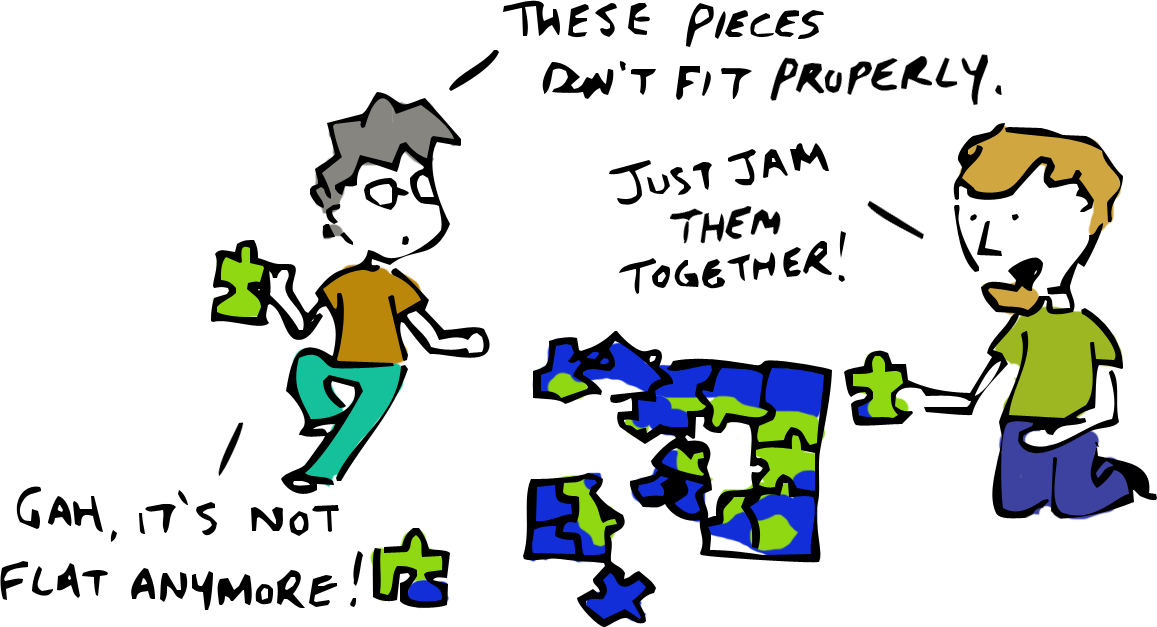
To really understand volcanoes you need to understand plate tectonics. Since this article is meant to focus on the former, I will sum up the latter in a single sentence: The Earth’s surface is made up of enormous plates that fit together like a badly made jigsaw puzzle, moving around and smashing into each other to produce all the features of the planet’s landscapes.


When plates pull apart from one another, hot rock from beneath bubbles to the surface and you get a spreading zone volcano. 


When two plates smash into each other, one is forced beneath the other (AKA subduction) where the pressure and friction cause the rock to melt. Eventually that rock finds its way up through cracks in the surrounding material to the surface and you get a subduction zone volcano. 


When you have a plate with a weak spot and some particularly hot and motivated magma beneath it, you get an intraplate volcano.


Beyond that, volcanoes don’t like it when you try to come up with general rules about them. Spreading zone volcanoes tend to be the least explosive, but Iceland is really just a combination of these sorts of volcanoes and explosive eruptions there have halted global air traffic and cost the world economy billions of dollars. Intraplate volcanoes tend to be the most destructive, but the Hawaiian hotspot has been quietly erupting more or less constantly for at least the past thousand years.


Clearly, volcanoes are full of surprises. Unfortunately they are rarely the kind of surprises that you look forward to. In 1980, volcanologists in Washington state watched and waited while Mount Saint Helens swelled and rumbled, expecting either an impressive vertical eruption or for the volcano to slowly go back to sleep. No one predicted the lateral (sideways) explosion of ash and debris that killed 57 people and flattened 200 square miles of forest.

The most recent surprise that volcanologists have unearthed is one that they seemingly should have discovered quite a while ago. On September 6, 2013, scientists announced that they had discovered the largest volcano on Earth (so far). Tamu Massif as the peak is known rises 3.5 km from the sea floor about 1,600 kilometers east of Japan and occupies an area of 310,000 square kilometers, making it about the size of the British Isles. The volcano formed over millions of years as eruptions piled up one on top of another and collapsed outwards and upwards, although the summit still lies about 2,000 meters (6500 feet) beneath the waves.


Tamu Massif is being compared to another massive volcano called Olympus Mons which is found on Mars and still holds the title of “biggest volcano in the solar system.” Until now, mountains as big as Olympus Mons were not thought to exist on Earth. The reason is took so long to find the behemoth volcano is that the world’s oceans are one of the few things that are less well understood than volcanoes themselves. Also, scientists originally thought the formation was the result of multiple volcanoes joining together. The recent breakthrough was in establishing the existence of a single vent responsible for forming Tamu.


It’s pretty incredible to think that something like the world’s biggest volcano could exist beneath the ocean, unknown to people, until the 21st century. It really makes you wonder what other incredible things lay hidden by water and question whether or not it’s a good idea to keep dumping radioactive waste and movie directors into the depths.


Friday, 1 November 2013

Sketchy Fact #13: DNA in Spaaaaaaaaaaace!

If you stretched the DNA from a single cell into a fine thread it would be 2 meters (6.6 feet) long. All the DNA from all your cells arranged in a line would be twice the diameter of the solar system.


Wednesday, 30 October 2013

The Heat Death of the Universe and Other Horrible Topics for Light Dinner Conversation

We have had a bit of a rough ride this month, learning about the dangers of space. From stars expanding to comet and asteroids crushing us from above we have seen that there is no shortage of potential assassins in this Universe of ours. But what if the Universe itself were to put an end to life? And not just life on Earth, life everywhere. It is not only possible; research has shown that it is downright probable.


To understand what it is about the Universe that all but guarantees an end to life as we and everything else knows it we have to take a physics lesson from a half-crazy, reclusive nut job genius named Isaac Newton. Most people know Newton from the story of him getting beaned with and apple and conceiving gravity as an idea. Most people don’t know that he also devoted a good portion of his life to things like trying to turn mercury into gold and sticking needles between his eyeball and eye socket to see what would happen. But as crazy as he may have been, he was equally brilliant. Beyond gravity, he bestowed upon science the 4 truths about the universe known as the Laws of Thermodynamics.


The fours laws are an article in themselves so I will leave a thorough explanation for another day. What concerns us now is the concept we get from them that is called entropy. Entropy is disorganization. It is the idea that as time goes on the elements of a system that are able to do work get used up and productivity declines. A favourite way to think of it is in terms of a game of billiards (read Bill Bryson's A Short History of Nearly Everything). At the start of the game, the balls are all very close together (low entropy) so it is easy for them to bash into each other and exchange energy. That is why when you break at the start of the game the balls all fly off in every which direction. As the game goes on entropy increases as the organization decreases, eventually leading to a state where you have to plan and target shots over a greater distance to get any work done at all (high entropy).


The Universe is a little bit like that game of billiards. In the beginning, everything was tightly packed together. In fact, all matter was a single point of immense potential energy. The Big Bang is the result of that potential energy and the equivalent of the break at the start of the game. The problem with the Universe is that there aren’t any edges to the table so things can expand forever and the interaction between particles will eventually become non-existent. This is known as The Heat Death of the Universe.


It’s not the cheeriest idea in astronomy but it has been around for a while. Einstein first saw the potential for infinite expansion when he established his Theory of Relativity. He hated the thought so much that be tacked on an extra term to one of this most important equations that fudged the math just enough to reassure him that gravity would eventually stop the expansion and hold everything together. He called it the Cosmological Constant.


Eventually as more evidence came in from work done by Edwin Hubble (who later had a space telescope named in his honour) suggesting that the Universe was expanding at an increasing rate, Einstein came to regret his constant and the wishful thinking it embodied. Modern scientist, however, are re-warming to its use as an explanation for the increasing speed at which the Universe is being flung apart.


The Cosmological Constant is being repurposed to account for the bizarre energy that seems to exist to counteract gravity and push things further and further away from one another. The eventual outcome (don’t worry, this is eons in the future) will be total heat death. The Universe will be an evenly distributed cloud of protons. Cold and impotent in the vastness of space… I guess we better enjoy our cosmic game of billiards while things are still energetic enough to allow it.


Friday, 25 October 2013

Wednesday, 23 October 2013

Comets, Asteroids, and Bruce Willis: The Science of Blunt Force Trauma to the Earth

One thing you quickly learn as you write a suite of articles about space and the dark beyond is that there are a lot of things in the Universe that can kill you. Gamma rays, black holes, solar flares; there is no shortage of topics to make the hair on the back of your neck stand up. There is one threat, however, that is closer to home than all the rest both in terms of distance and presence in the human mind: Impact.


There is something powerfully unromantic about it. Of all the ways the human race could be brought to its knees, a collision by a comet or asteroid is the most blunt and unimaginative. If the Universe were a movie villain black holes and gamma bursts would be the James Bond disaster scenario. Impacts are the celestial equivalent of getting hit over the head with a pipe.


Even still, we stand in awe at the possibility of being hit with such a massive pipe. A plethora of movies have painted varyingly plausible doomsday situations featuring rocks from the sky, and these movies are where most people get their information from. Unfortunately, Bruce Willis and a team of oil drillers aren’t always the best teachers.

There are three places from which falling death can originate. The first, and closest to Earth is the home of asteroids and it lies in the vast track of space between Mars and Jupiter that marks the boundary between the inner and outer solar system. When most people think of the asteroids belt they envision a tightly packed maze of rocks that spaceships must deftly maneuver through with the greatest of care. In truth, it is a pretty roomy place. A flight through the belt is a bit of a letdown in terms of site seeing. Asteroids of any significant size are an average of 5 million kilometers apart. The collisions between asteroids that send them careening onto a path that threatens the Earth are exceedingly rare with an average rock getting bumped once or twice in its several billion year long life. Nevertheless, it happens.


The other two breeding grounds for swift cosmic death are further out in space and are the hideouts of short period and long period comets. They are known as the Kuiper Belt and the Oort Cloud respectively. The Kuiper Belt lies just beyond the orbit of the most distant planet (Neptune) and is home to both comets and planetoids (AKA dwarf planets) like Pluto and Eris. When comets get knocked out of the Kuiper Belt they take on long elliptical (egg-shaped) orbits that pass through the inner solar system once or twice in a human lifetime. These comets are subsequently called “short period comets.” Objects from the Oort Cloud take on much longer orbits and become long period comet. Their orbits can take 1,000, 10,000, or even a million years to orbit the Sun once.


It is all well and good to know where these things come from but the real question is when can we expect one for dinner? It must be said that comets and asteroids are notoriously bad houseguests and you don’t want to be surprised by their arrival. The dinosaurs can vouch for that. It turns out that a sizeable impact happens once every 300,000 years or so with smaller objects burning up in the atmosphere daily or even hourly.

The major impacts are not something you want to be around for. Even a relatively small object (~1 km across) would release a million times more energy than the bomb dropped on Hiroshima and create global chaos. Evidence of past collisions can be seen at meteor crater in Arizona (3.8 km/2.4 miles in diameter), the Chicxulub Crater in Yucatan, Mexico that is believed to have been left by the object that marked the end of the age of dinosaurs (180 km/112 miles in diameter), and in the Sudbury Basin in Ontario, Canada (250 km/160 miles in diameter).


As is evinced by the scale of the holes they leave in the ground, impacts are major events that alter the course of history. It is unclear whether or not humans could survive an event like the one that the dinosaurs faced 65 million years ago, but one thing is certain: Bruce Willis won’t be taking phone calls when we find out that something is on its way.