Showing posts with label conservation. Show all posts

Wednesday, 30 March 2016

The Butterfly Effect: Grow Weed to Protect Monarchs

If you grew up during the 90's in Southern Canada, Northern Mexico, or anywhere in between, you probably have some fond memories involving Monarch butterflies. While the best that most insects can hope for is humans not noticing them, Monarchs have attained a special place in many people’s hearts mostly because they don’t bite and are strikingly beautiful. The orange, black and white wings of these creatures are so well known that they are probably the default image many of you think of when you hear the word “butterfly.”

Nothing gets to be as popular as Monarchs are, without either a really clever or unbelievably pervasive marketing campaign, and butterflies have opted for the latter. During the 90's, Monarchs were everywhere. I remember days in the schoolyard as a kid when, if the custodian had been particularly neglectful in mowing the lawn, you would have to walk through clouds of fluttering wings to get to the baseball diamond or the sand pit. I used to catch caterpillars and raise them into adults. It was a scene out of a damn fairy tale, but like most fantastic moments in life I didn’t appreciate it until it was over.


It has been a long time since I got to walk through a swarm of Monarchs and that isn’t just because I don’t spend my afternoons attempting to move enough sand to reach China; it’s because the butterflies that defined much of my childhood are disappearing.

It’s not that some evil person or corporation has set out on a mission to wipe out the Monarchs. It actually is the fault of a company many people would argue is evil (Monsanto – another story altogether), but even they aren’t doing it on purpose. See, much of the trouble for Monarchs can be traced back to the fact that they depend on a plant we consider a weed for their survival. They lay their eggs on, spend their caterpillar-hood living on, and exclusively eat Milkweed. Our prejudice for the plant is right in the name.


Milkweed used to be everywhere, mostly because it is incredibly hearty. Give Milkweed half a chance and it will spread like wildfire across farm fields, backyards, playgrounds, railroad tracks, and wherever else there is sunlight and soil. Unfortunately, thanks to genetically modified crops and advances in pesticides, Milkweed has had significantly less than half a chance to grow for the past two decades. On top of this, the forests in Mexico, where Monarchs spend the winters, have been decimated by illegal logging and climate change is making their migration tougher every year.

One of the most incredible things about Monarchs is the distances they travel. It isn’t that a single, massive population constantly exists all across North America; every spring, Monarchs in Mexico take to the sky and fly north. It is this migratory population that exists at different times of the year all over the map. That is part of the challenge; when you rely on so many different places to be environmentally intact, you are very vulnerable to one of them dropping the ball.


In the mid-90s, the total population of Monarchs was estimated at around one billion insects. Since then, thanks to the death of Milkweed and the other factors mentioned above, the population has fallen by over 84%. During the winter of 1996-1997, trees that were literally weighed down by blankets of butterflies covered over 18 hectares of land in Northern Mexico. By 2013-14 the area was less than one hectare. Things are bad in butterfly land.

Fortunately, there is hope. Citizens and environmental groups across the three countries where Monarchs range have taken action. This year, the group Monarch Watch in the US plans to distribute between 200,000 and 300,000 Milkweed plants for people to plant. In Canada, groups like the David Suzuki Foundation are doing the same. Along with these efforts, groups are working with farmers to rent land on which Milkweed can regrow, in what is called an “exchange.” The idea is that farmers rotate spraying pesticides on different areas of their land, setting aside a little each year for Monarch habitat.

Even still, the bugs are in trouble. This past winter saw a pretty impressive recovery in Monarch numbers, before a freak spell of frigid weather in Mexico wiped out as many as 100 million butterflies.


Fortunately, this is a problem you can easily help correct. Go online and find a group near you that is selling Milkweed and get to greening your thumb. If you’ve wanted to get into gardening but don’t think you have the skills, what better way to build confidence than to actively try to grow a weed? With any luck, the butterfly population will grow with your horticultural ego and generations of schoolchildren will be all the better for it.


Friday, 8 May 2015

Sketchy Fact #90: A Breath of Fresh Air

A 30 meter tall tree can produce 2,721 kg (5,998 lbs) of oxygen in a year. Enough to support two people.

Wednesday, 12 November 2014

New Orleans is Sinking... No, Seriously

A couple weeks ago we took an internet-fueled trip to China to learn about the Gobi Desert, which is threatening to consume Beijing. The Chinese government and its people are hard at work trying to erase the environmental degeneration that has led to their battle with the so-called “yellow dragon” but they aren’t the only people who are at risk of losing their homes to a pissed-off planet. You may not realize it, but the people of the state of Louisiana are up against their own dragon, only it is bluer, wetter, and a whole lot bigger.

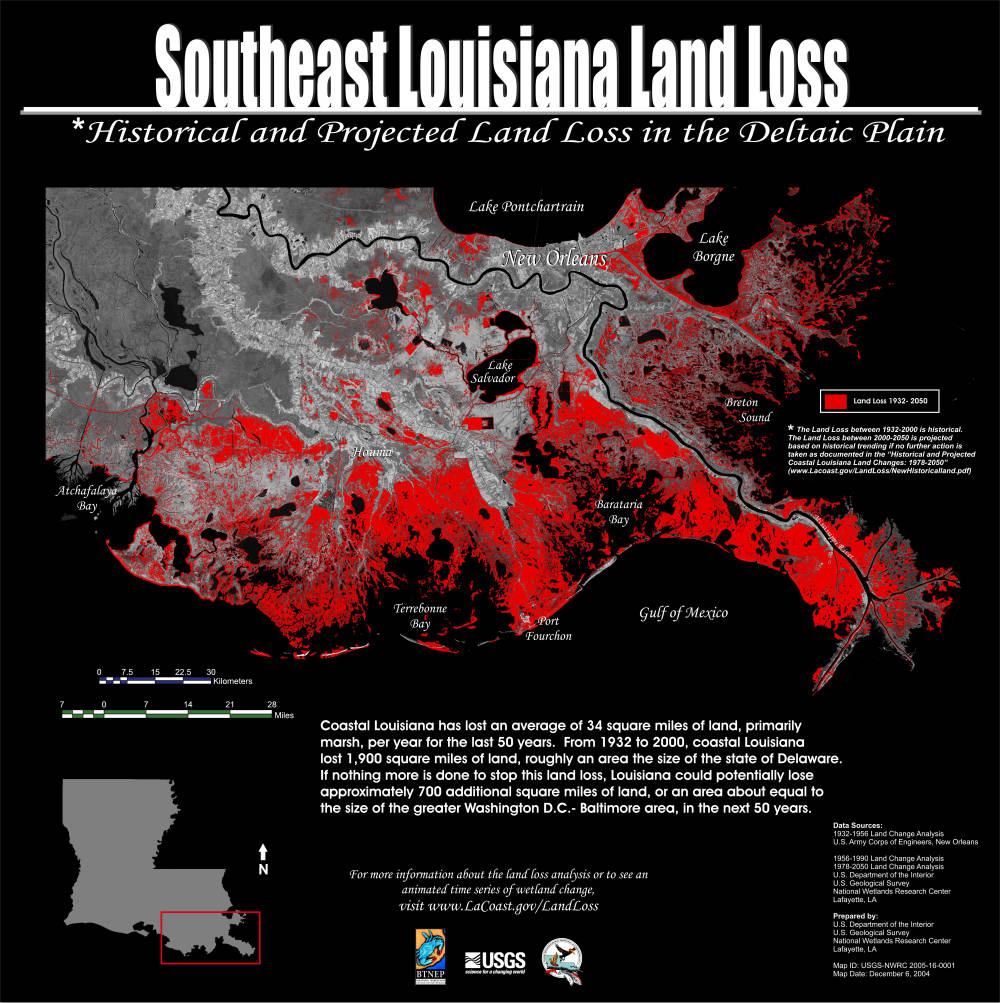
Since 1932 the slow but steady lapping of water from Gulf of Mexico against Louisiana’s shores has caused around 1,900 square miles (almost 5,000 km2) of land to fall beneath the waves. If the current trend of erosion continues, geologists expect that the total loss of land could grow by another 1,750 square miles (4,500 km2) in the next 50 years. That number is kind of ridiculous. The projected land that could be lost by mid-century is bigger in size than the state of Delaware combined with the greater Washington, DC/Baltimore area, just gone.


Ironically enough, what is causing Louisiana to drown is pretty much the same thing that is drying out China. As the population of the state has grown and industrial interests have mowed over environmental concerns, trees have been cleared and wetlands have been paved over or cleared out to make room for people. When that happens, the root systems of plants wither away and with them goes the stabilizing effect they have on soils. When the ground is only loosely held together, it doesn’t take much in the way of waves to break it apart completely.


Unfortunately for Louisiana, their waves have also gotten stronger. If we completely set aside the idea that climate change could be making storms stronger by warming ocean temperatures, and if we decide to forget recent whoppers like Hurricanes Katrina and Sandy, we are still left with a state that has lost its buffer against the waves. When Europeans first showed up in Louisiana and set to work perfecting the way people cook seafood, they caught their shrimp and craw-daddies in a huge network of swamps and wetlands. What they probably didn’t realize as they cleared those wetlands was that they were basically taking the shocks off their car. See, when a really big storm nears land it kicks up a lot of water and generates what is called a storm surge. A storm surge is a massive wave that hits shore ahead of a hurricane. What swamps and wetlands do is absorb most of the blow and contain some of the energy, protecting the spaces further inland.


All-told, Louisiana is in a little over its head with all this. Fortunately for southern environmentalists, there was a massive oil spill in the Gulf of Mexico a few years ago… Okay, actually it was a terrible ecological disaster that the region is still recovering from, but it came with a silver lining. Court rulings in the wake of the Deep Horizon spill have forced BP to fork over as much as $18 billion in penalties for negligence. 80 percent of those dollars are designated for coastal restoration. With the total cost of restoration plans falling somewhere between $50 and $100 billion there will still be a chunk of change unaccounted for, but picking BP’s pockets is a great start.

If the 19th and 20th centuries were characterized by people plowing over nature in a mad dash to acquire as much personal comfort as possible, the 21st century is shaping up to be one where we make amends. Between trees getting planted in China, wetlands being restored in Louisiana, and a score of other massive environmental efforts underway all over the world, humans are repairing damaged environments on a scale never before conceived of. It’s going to take more than flowers and a box of organic, fair-trade chocolates to get mother nature to forgive us for our wrongs, but at least we are beginning to apologize.


Wednesday, 1 October 2014

The Green Wall of China: How to Fight a Desert

Beijing is a pretty important place. China’s capital and largest city is not only home to over 21 million people, it is the seat of power for the world’s most rapidly developing country. Consider the fact that over the past 3 years China has used more concrete than the United States did in the entire 20th century and you can begin to understand how quickly the world’s most populous country is catching up to the west.

 All that development comes at a cost, however; and since the late 70’s Chinese officials have been hard at work fighting what they call the yellow dragon and the rest of us call the Gobi Desert. You see, overgrazing, deforestation, and drought throughout China have caused soils to erode and blow away, leading to the advancement of the Gobi and an intensification of the annual dust storms that pound Beijing and bring Asian dust particles (as well as pollution) across oceans to the west coast of North America.


This environmental degradation is not unheard of. Most people are familiar with the dust bowl that devoured over 4 million acres of the North American plains in the early 20th century. Those conditions were cause by exactly the same actions that have created the problems in China. Too many cows eating all the grass, the grass dying because of drought, top soil destabilizing because there are no plant roots to hold it all in place. Gradually the top soil blows away, with disastrous consequences.


So what can be done to stop a desert once it gets to marching? In the US the answer came in the form of a 100 mile (160 km) wide strip of trees running north to south through the country which reduced the amount of dust in the air by 60% in a few years. Since the 1970’s China has been hard at work building a forest of their own, the Green Wall of China.


The scale of the Chinese reforestation effort boggles the mind. While the UN estimates that only 2% of China’s natural forests remain intact, the country plans to plant enough trees to increase its forest cover to 42% by 2050. Over the past ten years alone, Chinese citizens have planted over 56 billion trees. Each year they plant twice as many trees as the rest of the world combined. So, is it working?

The results, it turns out, have been mixed. While China is now approximately 20% forest-covered those forests aren’t exactly as natured intended them to be. Apparently planters in the north have relied almost exclusively on poplar trees, people in the south have planted firs, and elsewhere forests are almost entirely eucalyptus. The practice of planting only one kind of tree is called monoculture, and it is very risky business.

A forest with only one kind of tree has a lot of the same problems as a baseball team where everyone is a right-handed batter. In the short-run they might win a few games but eventually they will come up against a left-handed pitcher and things will fall apart as we saw in our discussion of left-handed people. Likewise, a monocultured forest might look alright at a glance but if a disease finds its way in which effects one of the trees, it is likely to take them all down at once. This is exactly what happened in Ningxia in northwest China when in 2000 a pest wiped out over a billion trees representing 2 decades of planting.


Monoculturing isn’t the only problem facing the green wall. While the poplars protecting Beijing seemed like a great idea when they were planted (because of the fast growth rate and toughness of the trees) they are now dying off because they were all grown from cuttings, which have a shorter lifespan than trees grown from seeds (30 to 40 years versus several hundred).  

A solution to the problem might, ironically, lie in a plant that China devoted much of its energy to eliminating in the 80’s and 90’s called sea-buckthorn. Buckthorn is a shrubby bush that grows along river banks and was previously thought of as a pest because its root system burrows deeply into soil and is almost impossible to remove. That, however is a horticultural perfect trait for battling a desert. Mixed forests of sea-buckthorn and poplar have already shown a lot more promise than poplar forests alone. It turns out that using China’s native trees rather than ones chosen by planters might be the smarter way to go about things.

Reforesting China is not going to be easy. The northern part of the country is a lot more arid than places with successful reforestation campaigns like the US, Germany, and Siberia. In order to stabilize the Gobi, China will have to learn quickly that the solutions to its problems are more likely to be found along its own river banks and in its remaining natural forests than in the policies of other nations.

Wednesday, 13 August 2014

Giant Boat-Knives and Other Bad Decisions: The Tale of the Basking Shark


Our friends at The Starfish asked us to drop some knowledge on basking sharks for Shark Week. Ask and you shall receive:

The ocean is full of monsters. That is a pretty well established fact. Any parent who has ever told an insomniac child, awake and trembling at 3AM, that there is no such thing has clearly never seen a picture of a giant squid or an angler fish. Sea monsters range from the very small (jellies) to the unfathomably enormous, but few are as impressive as the basking shark (known to science by the delightfully gladiatorial name of Certorhinus maximus).

Basking sharks fall into the “sea monsters” camp mainly because of their size. They are the second largest fish in the ocean (after whale sharks), reaching lengths of up to 33 feet and weighing as much as 8,000 pounds (3,600 kg). They also look unmistakably ferocious in that classic sharky way. They have dorsal fins that stick high out of the surface of the water, streamlined bodies, and (scariest of all) enormous mouths. You could swim into a basking sharks mouth pretty easily without ever touching the edges.


The thing about basking sharks though, is that they aren’t ferocious at all. Like so many of the biggest things in the ocean, they are almost comically gentle. They cruise around at around 3 mph (5 km/h) with their mouths agape, swallowing tiny plankton and filtering out massive amounts of water. They love to hang out in the sun right at the surface of the water, hence their name.


Unfortunately, this affinity for sunshine and their ridiculous size has caused some trouble between us and them, but not for the reasons you might think. Whereas humans normally hunt things as impressive as basking sharks for trophies or meat, these lumbering beasts are actually pretty useless as a commodity (unless you’re one of the 3 people alive who enjoy Icelandic hakarl).


The problem with basking sharks is that back in the 1940’s and 50’s they routinely got caught in fishermen’s gill nets by mistake. You may think that a basking shark would make a good catch for a humble fisherman, but the only sellable part of the great fish is its liver. I say “sellable” instead of “valuable” because in the mid 20th century basking shark livers sold for 3 cents a pound (about $35 per shark) whereas the nets they destroyed with their massive bodies cost roughly ten times that much.


This inevitably led to fishermen hating basking sharks and complaining to the government. In 1949 the Canadian government gave in and labeled basking sharks marine pests and set to work at killing them. The method of choice was either ramming them with boats or slicing them in half with a huge makeshift blade mounted on the bow of a boat. In the 1950’s a giant boat-knife was an impressive thing, at least impressive enough to be featured in the November 1956 issue of Popular Mechanics magazine.


The giant knives proved remarkably effective and in a matter of decades basking sharks were nowhere to be found. Nowadays there is about one sighting per year off the British Columbia coast. Ask someone at the Department of Fisheries and Oceans where they went, and you will likely get a sheepish, embarrassed look in return.


However, the news isn’t all bad. In 2010, Canada followed the lead of countries like Ireland and Great Britain and declared the basking shark endangered. A recovery strategy was finalized in July 2011 and the people who once drove the knife-boats have since been at work mashing the ocean’s CTRL+Z key. Only time will tell if they’ve changed their minds in time.


Friday, 2 May 2014

Sketchy Fact #38: Emotional Orcas

Scientists believe that Orcas (Killer Whales) are the second most cultural animals on Earth after humans. Scans of their brains show huge areas devoted to emotion and analytical skills. Separate groups have completely different hunting techniques and are even thought to have their own languages.