

Friday, 18 April 2014
Sketchy Fact #36: Avast, Ye Scurvy Guinea Pigs!
Most wild animals don't ever get scurvy because they create Vitamin C inside their bodies. Humans, guinea pigs, and bats are among the few animals that can’t make their own Vitamin C.

Wednesday, 16 April 2014
Infecting with Immunity: How Vaccines Actually Work
One of the major challenges scientists face is communicating important
information to the general public. As brilliant as many of them are, hours
spent in a lab hunched over a microscope do little to improve a person’s
ability to explain things simply and comprehensibly. Complicating things
further is the fact that scientists are trained to constantly question and test
their ideas so they say a lot of things like “we believe” and “these results
suggest” when really they mean “I am sure this is true, these are facts.” When
you’re talking about the evolutionary history of Amazonian frogs or something
like that, it tends not to matter; but occasionally a topic comes along where a
clear explanation of how things work is even more important than a detailed
reporting of the facts. Vaccines are one of those topics.

Right now in the Fraser Valley of British Columbia Canada, several
hundred people (mostly children) are infected with an unpleasant and
occasionally fatal illness that scientists basically cured a long time ago.
Over 200 cased of highly contagious measles have popped up in the region and a
few infected people have found their way to Ontario and the Atlantic coast, largely because the Fraser Valley has one of the lowest measles
vaccination rates of anywhere in Canada (between 70 and 80%).
Much of the problem lies in the fact that vaccines inject viruses and
bacteria into people’s bodies. Generally speaking we are taught that this is a
bad thing, so our instinctive reaction is to avoid it. Teaching people that
infections are bad and then telling them that you need to inject them with a
virus is generally a hard idea to sell because, quite frankly, it makes you
seem insane.

The truth is vaccines actually are made of the viruses and bacteria that
they are trying to prevent. To understand why that is necessary we need to
understand the immune system. You see, when an unfamiliar virus or bacteria
makes its way into your body it sounds an alarm that activates an immune system
response. These invading organisms are called antigens and their goal is to
replicate as much as possible.

Since our bodies are not designed to handle that
sort of thing the results can be very bad, resulting in sickness and sometimes
even death.

Your body doesn’t like dying, so once that alarm is sounded you’re white
blood cells get to work. Your T-cells identify which cells in your body are
infected by the intruder and destroy then to try to contain the infection.
Meanwhile your B-cells produce antibodies, which attack antigens directly and
try to prevent them from infecting more of your body’s cells.

Vaccines take advantage of this response by tricking your body into
thinking it has been infected by a specific virus or bacteria, but in order to
do that they need to introduce some of these intruders into your body. Obviously
the goal of vaccines is to prevent infection so it wouldn’t make much sense to
pump you full of measles. Instead, vaccines use a weakened or inactive (dead)
form of the intruder/antigen.
Vaccines that use weakened antigens are called live-attenuated vaccines,
because they inject still living infections. The trick with live-attenuated
vaccines, however, is that they use the dumbest, laziest individual viruses and
bacteria possible. To create these vaccines scientists take something dangerous
like measles and give it a relaxed, cushy life in a test-tube. The infection is
continually transferred from one test tube to another, each time getting a
little more used to the good life. After enough time and transfers (77 in the
case of the measles virus) the infection is so used to not have to do anything
to survive that it has lost most of it’s tenacity. When injected into the
bloodstream these infections reproduce at most 20 times rather than the
thousands and thousands of times they normally would. Your body is easily able
to identify and destroy these antigens.

The cool thing is that you immune system has a great memory, so once the
infection is gone your B-cells continue to produce the antibodies that can kill
it, making you immune for life.
Inactivated vaccines use dead viruses that don’t reproduce at all. The
benefit to this is that there is zero chance of any kind of negative reaction
(live-attenuated vaccines can lead to soreness at the injection site and
occasionally some mild symptoms), the downside is that you often need multiple
shots to maintain immunity because your body thinks the disease is a dud.

One of the most publicized fears about vaccines is so-called link
between vaccination and autism. This link is a myth. It arose when some people
discovered that a disinfectant used in some vaccines (Thimerosol) contained
mercury. There is however no reliable research supporting this claim (Parker et
al., 2004). Even still, most vaccines now contain no Thimerosol because the
companies that produce the treatments want to make parents feel as safe as
possible. One real health concern that goes along this vaccines is the risk
that some flu shots pose to people with egg allergies. Since influenza is grownin eggs to create the vaccine, there is a chance it can cause an allergic
reaction. If you’re allergic to eggs to can still get a flu shot, you just have
to talk to your doctor about getting one of the varieties that is not developed
using eggs (there are plenty).


Friday, 11 April 2014
Sketchy Fact #35: Putting the "bow" in Rainbow
Rainbows are bent because we can only see the sunlight refracted through rain droplets at an angle of 42 degrees. The rainbow you see is the product of the sunlight, the droplets, and where you are standing. That means that if you move somewhere else you are actually seeing a new rainbow made by new raindrops beaming light to your new location, but always bending it 42 degrees first.

Wednesday, 9 April 2014
Sketchy Science Storybook Corner Presents: Curious Geoff and the Antibiotic-Resistant Superbug
The following is loosely based on actual events... But we made up a lot of the non-sciencey bits.
“Why didn’t you see a doctor sooner?!” exclaimed the man in the yellow
hat.
“Mind your own business.” Geoff replied in his increasingly raspy voice
to the only other person in the waiting room. He didn’t even know this guy and
after five minutes of conversation he was getting a lecture on personal health?
There were days when the usually agreeable illustrator for the 6th
most popular Canada-based, illustrated science blog on the internet would
have tolerated unsolicited advice, but this wasn’t one of them.

What had begun as a tickle in his throat had progressed over the past
month to become an omni-present burden on his existence. Every swallow and syllable he spoke ignited an intense fire just below his jawline and Geoff had had
enough. Fortunately he didn’t have to deal with this guy or his questionable
fashion sense anymore because the doctor’s receptionist stood and called his
name before a fist-fight could break out.

“Why didn’t you come see me sooner?!” The doctor asked. Still holding the recently-used tongue depressor in her right hand, the
question seemed all the more accusatory. Geoff didn’t really have an answer aside
from his hope that whatever was wreaking havoc on his esophagus would work itself
out.

“I’m going to give you some antibiotics. Make sure you finish the
bottle, even if you start to feel better.” The doctor scribbled something onto her
prescription pad, ripped off the page and handed it to Geoff in the manner of
an irritated police officer writing a ticket to someone caught speeding home to
watch the season finale of The Biggest
Loser. That is to say, she was both irritated and disappointed.

Over the next week, Geoff dutifully obeyed the doctor’s orders. Twice a
day he summoned his courage and drank a tablespoon of the goopy, greyish
antibiotic. "At least it came with a cool spoon shaped like an alligator" he thought to himself.
Pretty soon things appeared to be getting back to normal. Inside Geoff's body the medicine was beginning to turn the tide in his favour. Antibiotics can
either kill bacterial cells directly by impairing their ability to build cell
walls or they can smother them, binding to receptors on the outside of the
intruder cell and stopping it from interacting with the body. Geoff’s medicine
did the latter and it did it quite effectively… That is, until the weekend
rolled around.

Earlier in the week, Geoff had considered cancelling his planned weekend
adventure to the maple syrup factory with his friends. Now that he was feeling better, temptation got the best of him. By Friday he could hardly believe he had ever been
sick. He loaded up his suitcase, got on the bus and rode to meet his friends.
As he closed the door and turned the key to lock it, the half full bottle of
medicine sitting on the bathroom counter was the furthest thing from his mind.

By Monday night, the game had changed. As Geoff indulged his sweet tooth
with his friends, the bacteria in his throat had regrouped. Many of them had
been killed the previous week by the medicine, but those that were left were
the strongest of the strong. There had only been a few of them left when Geoff got on
the bus, but in the absence of the killing blow from the medicine, they had
multiplied. To make matters worse, a new bacteria had found it’s way into
Geoff’s throat over the weekend. It was a largely harmless bacteria but it
contained a piece of DNA that helped it form a smooth, slippery outer membrane.
This new bacteria made friends with the remaining disease causing bacteria and
(as bacteria sometimes do) they traded DNA. Now the bacteria that the medicine
had been meant to kill had mutated so that the antibiotic could not stick to
them properly.

The new and improved super-bug used its good fortune to regroup.
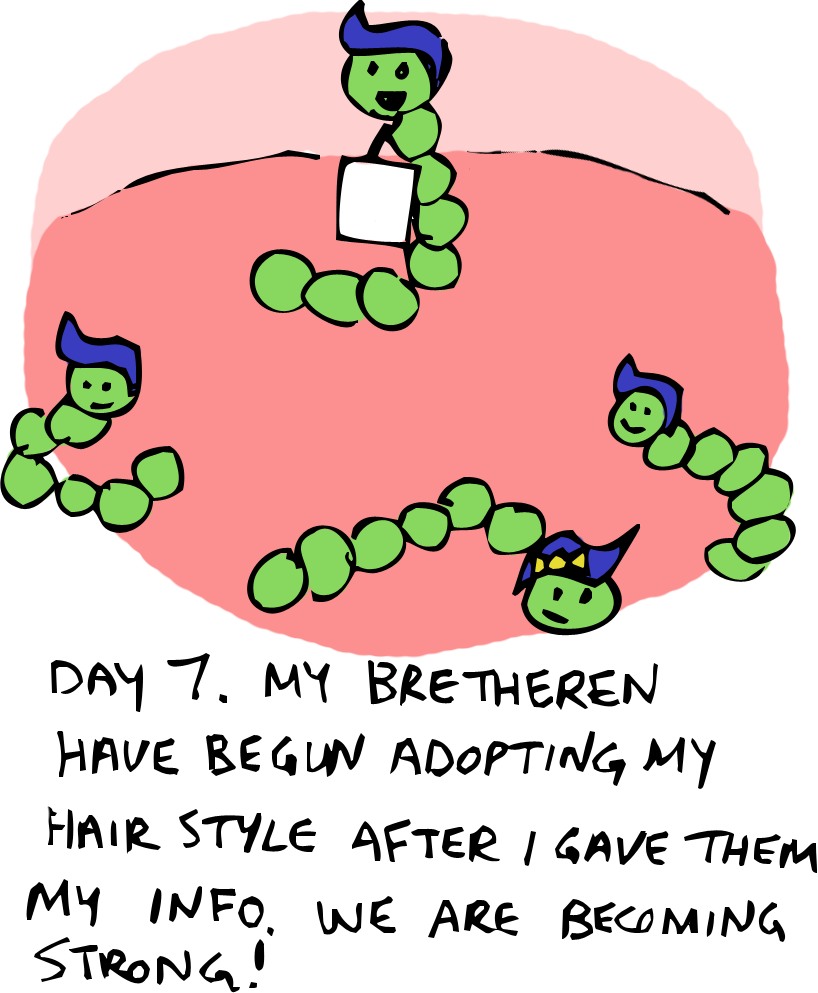
Things had gone from bad to worse.

When he got home, Geoff resumed taking his medicine, but it was too late.
The super-bacteria continued to multiply, unimpeded. He
went back to the doctor who prescribed stronger antibiotics, but before long
Geoff found himself in the hospital.

The next few weeks were rough on his body, but fortunately he was a young, physically fit person and over time his body was able to fight
off the infection. He lost a bunch of weight and had a miserable time (despite having all the jello he could eat), and as he left the hospital he vowed to never let
a bug turn super on him again.
Geoff would never know it, but the reason that his infection was able to
mutate was because of the steak he enjoyed on Friday night. Many farmers around
the world use antibiotics to help their livestock grow larger, faster. Over-using
antibiotics gives bacteria more chances to evolve
resistance to them. That is exactly what happened with the bacteria that
eventually traded DNA with Geoff’s infection.

From that day on, Geoff did his part to combat the evolution of
antibiotic-resistant bacteria. He didn’t take antibiotics when he had the cold
or a flu because he knew that these infections were caused by viruses and not bacteria. Viruses aren’t
alive in the same way bacteria are, so antibiotics are useless against them. He
also stopped using antibacterial hand soap and instead used alcohol-based hand
sanitizer which bacteria can’t evolve resistance to. Over many years, Geoff’s good behaviour
influenced his friends to do likewise. Eventually even farmers got the message
and stopped needlessly pumping animals full of medicine that could have been
used to help creatures that were actually sick.

And they all lived happily ever after… Except they got sick a lot from
viral infections, but that’s another story.
References:
Friday, 4 April 2014
Sketchy Fact #34: Speedy Sight
Dogs can detect movement and react to it far better than humans. If you’ve ever wondered why dogs are generally not interested in TV it’s because their eyes are so perceptive that they can see the gaps between the pictures that make up the video.

Wednesday, 2 April 2014
Plastic Wraps and Colony Collapse: All the Buzz from the World of Bees
If you’re the sort of person who keeps up with bee news, you are
probably not the best dinner guest. First off, although bees are very
interesting when you’re in the mood to nerd-out on them, you can only get so
much conversational mileage out of a single topic. Second, you probably end up
being the bearer of a lot of bad news.

Recent years have not been great for bees. You may have heard that
honeybee populations have been dramatically declining because of a mysterious
ailment called Colony Collapse Disorder (CCD). When a hive is hit by CCD the
bees lose their gusto for teamwork and all fly off on their own, leaving the queen to tend
to the larvae all by herself. The end result is a lot dead
bees and a lot of upset beekeepers.

No one is quite sure what causes CCD, but there is general agreement
that it is a pretty major problem. You may not realize it, but a lot of the
food you eat depends on bees for its production. Up to 15% of the fruits and
vegetables you eat are pollinated by honeybees. If you eat meat, another 15% of
your grocery list is made up of animals that eat plants that bees pollinate.
That means, without bees, up to one third of the shelves at the supermarket
would suddenly be bare.

There are a few competing theories about the origin of CCD. Mites or
viruses have been implicated as bee killers. A disease that impacts the bees
ability to navigate to and from their hives has been suggested. You also won’t
be surprised to hear that human behaviour may be playing a role. Beekeepers
routinely move hives around so the bees can pollinate specific fields and crops.
This could be stressing the bees out, leaving them more susceptible to whatever
causes CCD.

Another problem is the lack of genetic diversity among honeybees. When
we humans domesticate something, we tend to breed it with specific traits in
mind. That means that when we see something we don’t like, we remove it from
the breeding pool. The end result is a lot of bees that are physically and
genetically very similar. That may mean that they all show characteristics we
want (like a reduced tendency to sting), but it also means that they are all
susceptible to the same diseases.

Fortunately, there appears to be a few glimmers of hope for our striped,
buzzing friends. Research from the University of Guelph in Ontario, Canada has
found that some bee colonies are beginning to adapt to a human-dominated
world. Several species of wild, solitary
bees (unlike the hive-minded honeybees) have been seen using plastic materials from old grocery bags and window caulking to build their nests. Researchers
have found nests where up to one third of the plant material that is usually
used in construction has been replaced with scavenged plastics.

If it wasn’t cool enough that bees are changing their building code, the
changes seem to be having a positive effect. Offspring raised in the plastic
nests are significantly less likely to be impacted by mites and other parasites
that normally raise bee mortality rates.

So, as centuries of human interference in the domestication of honeybees
is leading to empty hives and withering crops; nature is adapting to some of
the garbage we are producing by recycling it into healthier nests for wild
bees. When you consider the fact that honeybees didn’t exist in the Americas
until Europeans brought them here in the 1600’s, and that their presence has
led to a decline in most wild bee populations, the irony really starts to sting.
Pun intended.
Friday, 28 March 2014
Sketchy Fact #33: Left-Handed Lunar Exploring
Approximately 62% of autistic children are left-handed, compared with 37% of non-autistic children. Buzz Aldrin is also left-handed. This in no way implies he is autistic, but it probably made driving the lunar buggy a bit annoying.

Subscribe to:
Posts (Atom)